Thailand Investment Visa for 3 Million Baht: Facts, Myths, and What the Law Actually Says
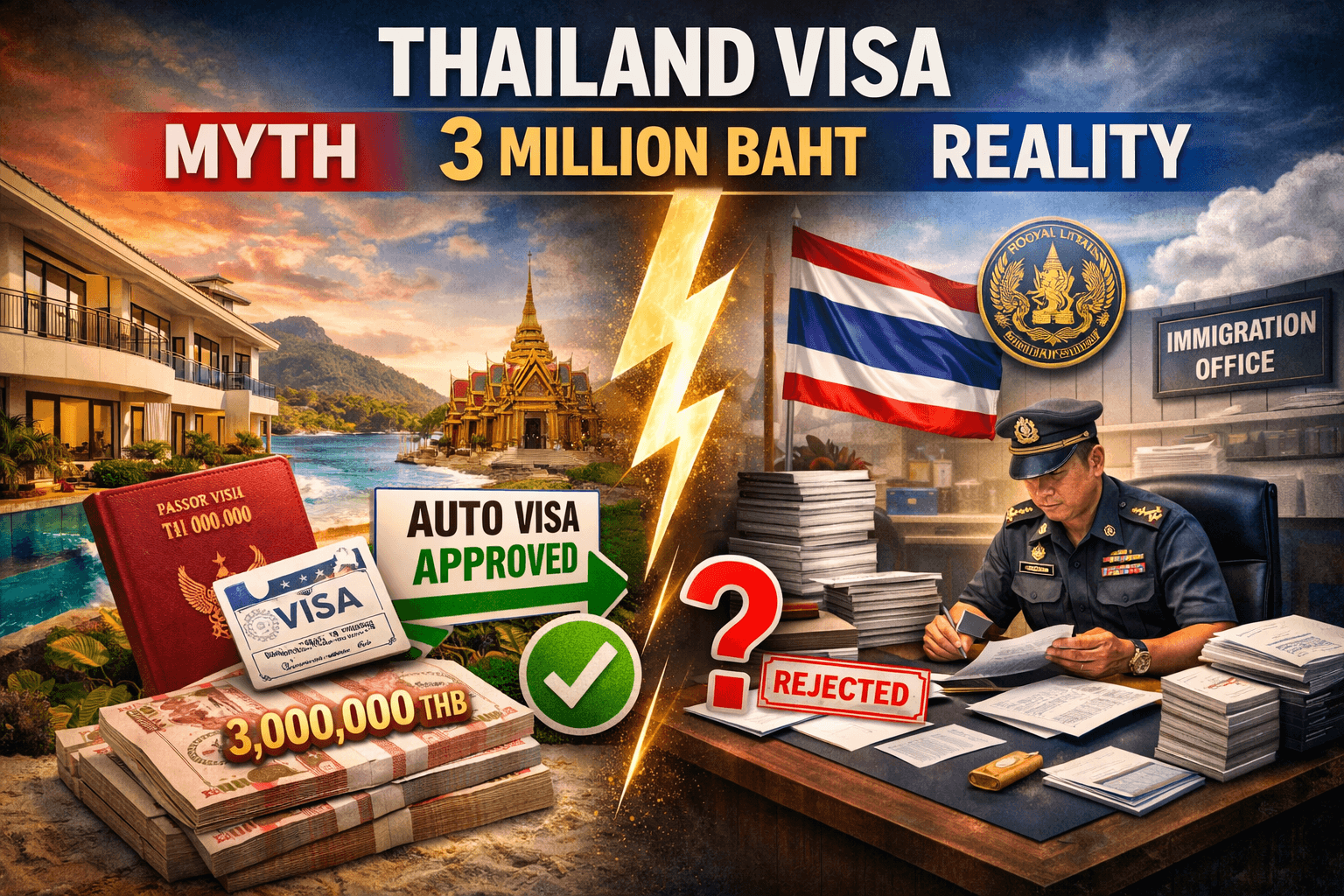
In 2025-2026, a persistent claim keeps circulating online: "Buy a property in Thailand for 3 million baht and get a visa." Some websites frame it as a "Thailand investment visa" or even suggest you can get residency in Thailand through real estate. At Thai Residence, we hear this question from clients on a regular basis - so we reviewed official documents, immigration authority guidelines, and Thai government publications to provide a clear, legally accurate answer, and we updated this article after new rules took effect in October 2025 that changed the picture.
The Short Answer
Before October 2025, the formula "buy property, get a visa" genuinely did not exist in Thailand. As of 1 October 2025, that changed: the Immigration Bureau introduced an official long-stay pathway tied to real estate investment of at least 3,000,000 THB (Orders No. 237/2568 and 238/2568).
It is not an instant or automatic visa: you still need certification through the Ministry of Tourism and Sports and a formal Immigration filing. But it is now a genuine official procedure, not a myth. Here's how it actually works.
Where the 3 Million Baht Figure Comes From
The figure of 3,000,000 THB does appear in official sources, but in a limited context that is often misread.
Non-Immigrant Visa B (Investor)
According to Thailand's Ministry of Foreign Affairs, a temporary Non-Immigrant B visa can be considered for foreigners who invest at least 3 million baht in approved instruments - a condominium, a deposit in a Thai bank, or Thai government bonds.
It's important to understand the fine print: this is a temporary visa typically valid from 90 days to 1 year, buying property alone doesn't grant an automatic right to it, the decision is made case by case, and in practice this route is used rarely and selectively. It isn't a "visa for buying a condo" - it's a standard Non-B where investment can serve as just one of several grounds.
The "Stay in Thailand for Investment Purposes" Program
Thailand's government portal does mention a stay option for investors from 3 million baht. But there's a key condition most articles leave out: this regime applied to foreigners who received entry permission before 1 October 2006. For new applicants, it effectively no longer applies.
What Changed on 1 October 2025
Thailand's Immigration Bureau issued two orders, No. 237/2568 and No. 238/2568, effective 1 October 2025. For the first time, they formalize what used to be guesswork: a long-stay pathway for foreigners who invest at least 3,000,000 THB in Thai real estate. The first permits under the new rules were issued from March through April 2026.
The process has two phases. First, applicants receive a 90-day permission to stay; then they must file for a 12-month extension of Non-Immigrant B status no later than day 70. The extension is valid for one year and renews annually, as long as the applicant keeps ownership of a qualifying property.
Phase | What Happens | Filing Window | Cost |
|---|---|---|---|
Investment check | An accredited operator verifies the property and issues a certificate through the Ministry of Tourism and Sports | 7 to 10 business days | included in the operator’s service fee |
Phase 1 | 90-day permission to stay | requires at least 20 days remaining on the current visa | per operator’s rate |
Phase 2 | 12-month extension of Non-Immigrant B status | must file by day 70 of the 90-day permit | 1,900 baht government fee plus the operator registration fee (around 4,000 baht in partner program rates) |
Annual renewal | As long as the property is still owned | every 12 months | 27,000 baht service fee per cycle, per family member |
The orders set out three routes. In practice, the most reliable one is the first: buying a freehold condominium.
Route | Condition | Status as of mid-2026 |
|---|---|---|
Freehold condominium | Ownership, worth at least 3,000,000 baht | Active, the main working route |
Long-term lease (leasehold) | Registered, 3+ years, payments totaling at least 3,000,000 baht | Set out in the orders; acceptance practice is uneven |
Sap-ing-sith (right over property) | Registered, 3+ years, payments totaling at least 3,000,000 baht | Set out in the orders; acceptance practice is uneven |
The most predictable route in practice is buying a freehold condominium in Pattaya or elsewhere in Thailand. For the leasehold and right-over-property routes, immigration office practice is still uneven, so check their current status right before applying.
You cannot file directly with Immigration. The investment must first be verified by an accredited long-stay operator, who confirms eligibility and issues a certificate through the Ministry of Tourism and Sports. This step takes 7 to 10 business days, and only after that can you book an Immigration appointment.
A spouse, unmarried children under 20, and parents aged 50 and older can be added as dependents, but only after the principal applicant receives the full 12-month extension. The whole family cannot apply at once.
The limitations are real. The status does not grant the right to work, does not lead to permanent residency, and depends entirely on keeping the property: sell it, and the status is cancelled. Each unit supports exactly one visa application - you cannot combine several properties to reach the threshold.
This is not a hypothetical option: one of our clients has already gone through the entire process under the new scheme and bought a condominium in Pattaya specifically for this program. The process confirms that the scheme genuinely works, but it takes time and guidance at every step, from verifying the property to issuing the certificate.
What Buying Property in Thailand Does and Does Not Give You
It's worth separating two things. On its own, buying a condo still doesn't grant a visa automatically, then and now: you still need a separate certification process and a formal Immigration filing, and the result is not permanent residency and doesn't include the right to work. But since October 2025, following the process correctly does lead to a genuine, long-term legal status - a path that simply didn't exist before now officially does.
What Actually Works for Long-Term Residency
In practice, foreigners planning to live in Thailand long-term use other visa programs. Each one solves a different problem, and none require buying property, though owning a home can be a convenient addition.
We break down every visa route - from the retirement visa and DTV to LTR and permanent residence - step by step in our Thailand visa guide.
Thailand Privilege (formerly Elite)
A paid privileged-membership program offering residence rights from 5 to 20 years. As of 2026, an expanded pricing structure applies: Bronze for 5 years costs 650,000 baht (available until 30 September 2026, after which pricing for new members will rise), Gold for 5 years starts at 900,000 baht, Platinum for 10 years is 1,500,000 baht, Diamond for 15 years is 2,500,000 baht, and Reserve for 20 years is 5,000,000 baht. It remains the most popular option for those who want to live in Thailand without ties to a job, a business, or mandatory property ownership.
LTR Visa (Long-Term Resident)
A BOI program for wealthy retirees, remote workers, high-income professionals, and investors. Grants residence rights of up to 10 years with the right to work. For the Wealthy Global Citizen category, requirements eased in 2026: the mandatory USD 80,000 annual income requirement was removed, leaving only an asset test - at least USD 1 million in global assets, of which at least USD 500,000 must be invested in Thailand. The Wealthy Pensioner category (age 50+) keeps its income or deposit requirements unchanged.
Retirement Visa (50+)
An annually renewable visa for foreigners over 50 who can show income of at least 65,000 baht per month or a deposit of at least 800,000 baht in a Thai bank.
Work and Business Visas
For those who run a business or are formally employed by a Thai company with a proper work permit.
What We See in Practice
Over years of working in the Pattaya property market, we’ve noticed a consistent pattern: clients who initially arrive asking "how do I get a visa by buying a condo" end up treating the two as separate questions. Some get a Thailand Privilege membership and buy a condo for their own use in parallel. Others choose the retirement visa and buy property as a rental investment. Some start by renting, to test out the area and lifestyle before committing.
With the new official 3-million-baht investment visa in place, a fourth scenario has emerged: some clients now deliberately choose a condominium with this specific program in mind, but they budget for certification and the annual fees upfront rather than assuming "buy it and the visa is in the bag."
What unites them is this: buying property and sorting out a visa are two separate decisions, and the best outcome comes from making both deliberately, not by following a formula from an ad online.
The Bottom Line
Before October 2025, the formula "buy property for 3 million baht, get a visa" genuinely did not exist in Thailand. Today the formula has changed, but it’s still not as simple as the ads suggest: an investment of at least 3 million baht in a freehold condo can lead to an official, annually renewable Non-Immigrant B status under the new program (Orders No. 237/2568 and 238/2568), but only after certification through the Ministry of Tourism and Sports, with annual fees, and without the right to work or a path to permanent residency. For anyone who needs more flexible or longer-term residency, Thailand Privilege, the LTR visa, and the retirement visa remain solid options.
Planning to Buy Property in Thailand?
We've worked in the Pattaya property market for more than 15 years and help clients choose real estate that matches their goals, whether that's investment, relocation, seasonal living, or the new 3-million-baht long-stay visa program. We don't sell visas and we don't file your Immigration paperwork ourselves, but we know the market inside out, work with vetted legal partners, and can help you make an informed decision. Get in touch - we'll walk you through how it actually works and find options that fit your budget and goals.
Frequently Asked Questions
As of 1 October 2025, yes, but not automatically. An official program is in force (Orders No. 237/2568 and 238/2568): an investment of at least 3 million baht in a freehold condominium can lead to an annually renewable Non-Immigrant B status, but only after certification through the Ministry of Tourism and Sports.
A 1,900 baht government extension fee, the certification operator registration fee (around 4,000 baht in partner program rates) plus a 27,000 baht annual service fee per renewal cycle, charged separately for each family member.
No to both. The status doesn't grant the right to work and doesn't lead to permanent residency. It stays valid only while you keep ownership of the property.
On paper, yes: a registered lease of 3+ years and a right-over-property (sap-ing-sith) arrangement are also set out in the orders. In practice, the most predictable route is freehold condo ownership; immigration office practice on the other routes is still uneven, so check their current status before applying.
It's tied to owning one specific property and doesn't include the right to work. Thailand Privilege and the LTR visa don't require buying a specific property to qualify.